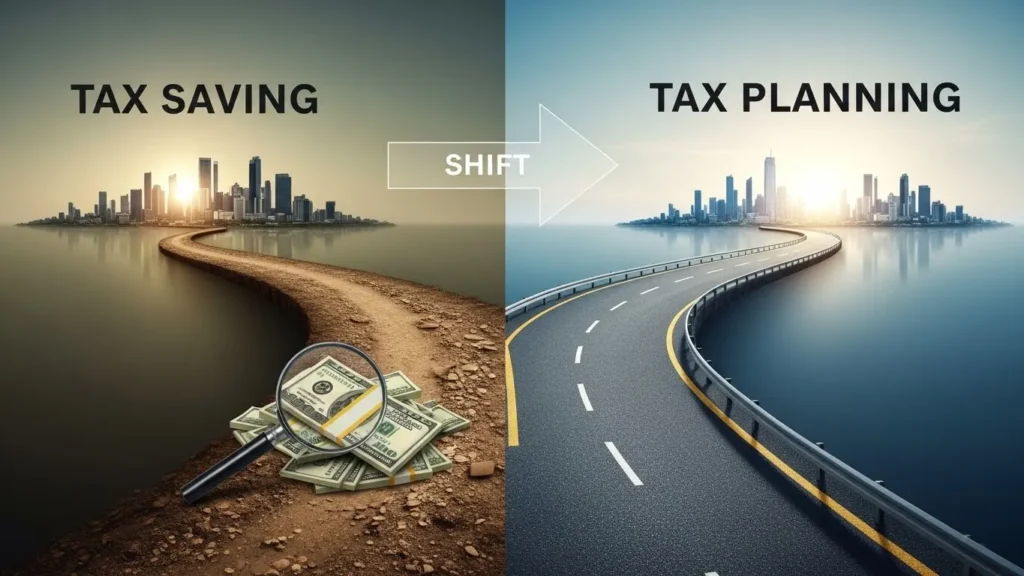
The Familiar Rush of “Saving Tax”
It happens every year.
The deadline gets closer.
Papers come out.
Someone mentions a deduction, exemption, or investment.
Suddenly, the focus shifts to one urgent question:
“How do I save tax right now?”
Money is rushed into last-minute products.
Decisions are made under pressure.
And once the filing is done, relief replaces reflection.
But here’s the quiet truth:
Most people who “save tax” every year still struggle to build lasting wealth.
Not because they didn’t try hard enough.
But because tax saving and tax planning are not the same thing.
Tax Saving vs Tax Planning — A Crucial Difference
Tax saving is reactive.
Tax planning is proactive.
Tax saving asks:
👉 How can I reduce this year’s tax bill?
Tax planning asks:
👉 How should my income, investments, and life goals be structured over time to reduce taxes legally and sustainably?
One looks at the present.
The other looks at the future.
And that difference changes everything.
Why Tax Saving Alone Often Backfires
Tax saving usually happens under pressure.
People buy products or make investments not because they fit their goals—but because they offer deductions.
Common problems with tax-only decisions include:
- Locking money into unsuitable instruments
- Ignoring liquidity needs
- Poor alignment with risk tolerance
- Overlooking future tax impact
- Missing better long-term opportunities
The result?
You may save tax today—but pay a bigger price tomorrow.
The Hidden Cost of Short-Term Tax Thinking
Saving tax without planning often creates invisible costs.
These costs don’t show up immediately.
They surface slowly—years later.
Examples include:
- High taxes at withdrawal or maturity
- Poor returns due to conservative or mismatched products
- Cash flow issues during emergencies
- Missed compounding opportunities
- Stress around future tax liabilities
Many people realize this only when they try to access their money—and find it inefficiently placed.
What Tax Planning Really Means
Tax planning is not about avoiding taxes.
It’s about organizing your financial life intelligently.
True tax planning considers:
- Income sources (salary, business, investments)
- Timing of income and expenses
- Long-term goals (home, education, retirement)
- Risk profile and liquidity needs
- Future tax brackets and withdrawal taxes
It’s a strategy—not a scramble.
A Simple Real-Life Example
Two people earn the same income.
Both want to reduce taxes.
Person A (Tax Saving Approach):
- Invests at the last minute
- Chooses products based on deduction limits
- Repeats the same pattern every year
Person B (Tax Planning Approach):
- Structures investments early
- Aligns tax benefits with long-term goals
- Diversifies across taxable and tax-efficient options
- Reviews strategy annually
After 15–20 years, Person B often ends up with:
- Higher net wealth
- Lower lifetime tax burden
- Better cash flow
- Less financial stress
The income was the same.
The mindset wasn’t.
Tax Planning Is About Lifetime Taxes, Not Annual Taxes
This is where most people miss the bigger picture.
The goal is not to minimize tax this year.
The real goal is to minimize tax over your lifetime.
That means sometimes:
- Paying slightly more tax today
- To save significantly more tax later
This shift alone separates short-term savers from long-term planners.
Tax Saving vs Tax Planning: Side-by-Side Comparison
| Aspect | Tax Saving | Tax Planning |
|---|---|---|
| Time horizon | Short-term | Long-term |
| Decision style | Reactive | Proactive |
| Focus | Deductions | Strategy |
| Investment choice | Tax-driven | Goal-driven |
| Liquidity | Often ignored | Carefully planned |
| Future tax impact | Overlooked | Anticipated |
| Wealth creation | Limited | Strong |
This comparison explains why planning quietly outperforms saving.
Why This Matters More Today Than Ever
Income structures are changing.
People now earn through:
- Salaries + side income
- Freelancing or consulting
- Investments and passive sources
- Business or digital income
Each income type is taxed differently.
Without planning, complexity increases taxes—not reduces them.
With planning, complexity becomes an advantage.
Common Tax Planning Mistakes to Avoid
Even people who try to plan often fall into traps.
Watch out for these mistakes:
- Confusing tax-saving products with good investments
- Ignoring exit or maturity taxation
- Failing to rebalance as income grows
- Never reviewing plans after life changes
- Assuming what worked earlier will always work
Tax planning is not “set and forget.”
It’s review and refine.
Actionable Steps to Shift from Saving to Planning
You don’t need to overhaul everything overnight.
Start here:
1. List Your Income Sources
Salary, business, investments, side gigs—each matters.
2. Define Clear Financial Goals
Short-term, medium-term, and long-term goals guide strategy.
3. Understand When Tax Is Paid
At earning, investing, or withdrawing—timing matters.
4. Diversify Tax Treatment
Balance between taxable, tax-deferred, and tax-efficient options.
5. Review Annually
Life changes. So should your tax plan.
These small steps compound powerfully over time.
Hidden Tip Most People Miss
Many people plan investments—but not withdrawals.
Tax planning works both ways:
- How money goes in
- How money comes out
Ignoring the exit phase can undo years of smart investing.
Planning withdrawals is where real tax efficiency is revealed.
Key Takeaways
- Tax saving is short-term; tax planning is long-term
- Saving tax alone can lead to poor financial decisions
- Tax planning focuses on lifetime tax efficiency
- Planning aligns taxes with goals, risk, and liquidity
- The biggest gains come from consistency, not urgency
Frequently Asked Questions
1. Is tax saving bad?
No. Tax saving is useful—but only when aligned with a broader plan.
2. Can tax planning reduce taxes legally?
Yes. Tax planning focuses on legal structuring, not avoidance.
3. Do salaried individuals need tax planning?
Absolutely. Salary growth, investments, and future withdrawals all need planning.
4. How often should tax planning be reviewed?
At least once a year, and after major life or income changes.
5. Is tax planning only for high-income earners?
No. Early planning benefits even moderate incomes through compounding.
A Simpler Way to Think About It
Tax saving is about this year.
Tax planning is about your life.
One reduces a bill.
The other builds stability, flexibility, and confidence.
When you stop asking,
“How do I save tax right now?”
And start asking,
“How should my money work for me over time?”
Everything changes—quietly, steadily, and powerfully.
Disclaimer: This article is for general educational purposes only and should not be considered personalized tax or financial advice.

Selina Milani is a personal finance writer focused on clear, practical guidance on money, taxes, insurance, and investing. She simplifies complex decisions with research-backed insights, calm clarity, and real-world accuracy.


Pingback: The Hidden Cost of Filing Taxes Late — Even When You Owe Nothing
Pingback: Common Tax Moves That Look Smart but Cost You Long Term
Pingback: Tax Planning Mistakes During Career Transitions — The Silent Errors That Cost More Than a Pay Cut
Pingback: Why Families Miss Out on Legitimate Tax Benefits — The Quiet Gaps That Cost Thousands Over Time
Pingback: How Poor Tax Planning Quietly Destroys Your Insurance & Investment Returns (And Most People Never Notice)
Pingback: The Silent Tax Risk of Side Income: Why Extra Money Can Quietly Cost You More Than You Think
Pingback: Why People Overestimate Tax Benefits — The Costly Assumptions That Quietly Drain Your Money
Pingback: Why Waiting Until Filing Time Costs You More in Taxes