The Decision You Still Think About
You didn’t buy.
The stock went up.
You noticed—but you moved on.
Later, you did buy something else.
It went down.
And that one still bothers you.
This isn’t a coincidence.
It’s human psychology.
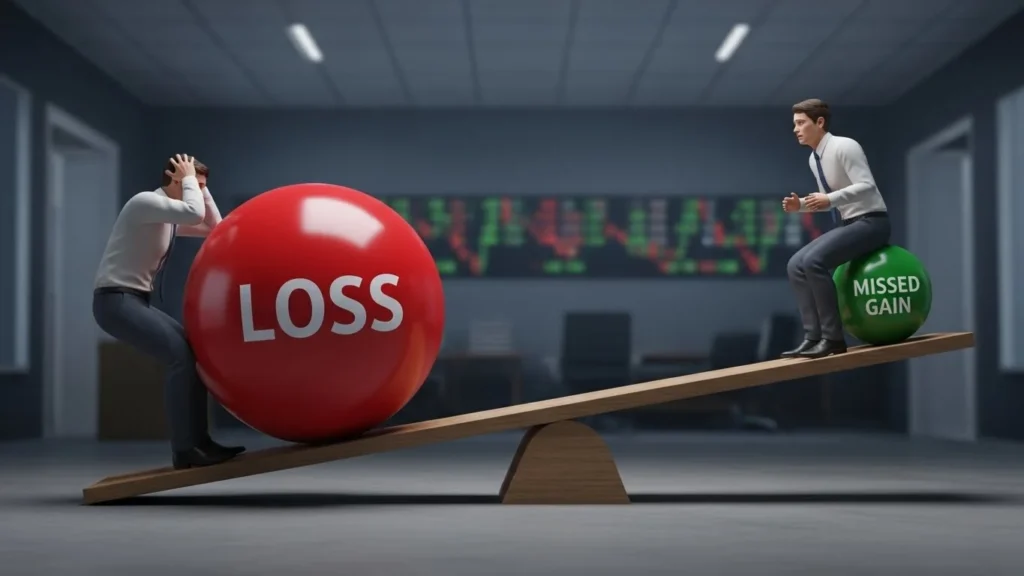
Investors don’t experience gains and losses equally. Losses hit harder, linger longer, and influence future decisions far more than missed opportunities ever do.
Understanding why investors fear losses more than missed gains is one of the most important steps toward better investing—and calmer decision-making.
Why This Matters Today (Even If You Think You’re Rational)
Markets move fast. Information flows faster.
But the human brain hasn’t changed.
Every day, investors face a subtle choice:
- Avoid a possible loss
- Or accept uncertainty to pursue a gain
Most choose safety—not because it’s optimal, but because it feels safer.
This emotional bias shapes:
- Asset allocation
- Timing decisions
- Selling behavior
- Risk tolerance
- Long-term outcomes
And most investors never realize it’s happening.
The Psychological Principle Behind the Fear: Loss Aversion
Behavioral finance has a name for this bias: loss aversion.
In simple terms:
The pain of losing is roughly twice as powerful as the pleasure of gaining the same amount.
Losing $1,000 feels worse than gaining $1,000 feels good.
This asymmetry drives behavior—often against our own best interests.
Why Losses Feel Personal (But Missed Gains Don’t)
Losses trigger:
- Regret
- Self-blame
- Fear of repeating mistakes
- A threat response
Missed gains trigger:
- Mild disappointment
- Rationalization
- “It could’ve gone the other way”
Losses feel like something was taken from you.
Missed gains feel like something you never owned.
Ownership—even imagined ownership—changes emotional intensity.
The Brain’s Survival Wiring at Work
From an evolutionary standpoint:
- Avoiding loss = survival
- Missing opportunity = inconvenience
Your brain is optimized to:
- Detect danger
- Prevent loss
- Prioritize certainty
Markets, however, reward:
- Calculated risk
- Long-term uncertainty
- Temporary discomfort
This mismatch creates friction—especially during volatile periods.
How Loss Aversion Shows Up in Everyday Investing
You can see it in common behaviors:
- Selling winners too early
- Holding losers too long
- Avoiding stocks after a downturn
- Sitting in cash despite long-term goals
- Overreacting to short-term losses
Each decision feels justified in the moment.
Collectively, they quietly reduce long-term returns.
A Simple Example: Two Equal Outcomes, Very Different Feelings
Scenario A:
You invest $10,000. It drops to $9,000.
Scenario B:
You don’t invest $10,000. It later grows to $11,000.
Mathematically:
- Both scenarios are a $1,000 difference
Emotionally:
- Scenario A feels painful
- Scenario B feels tolerable
The difference isn’t logic—it’s loss framing.
Losses vs Missed Gains: A Comparison
| Aspect | Losses | Missed Gains |
|---|---|---|
| Emotional intensity | High | Low |
| Memory retention | Long-lasting | Short-lived |
| Triggers action | Yes | Rarely |
| Causes regret | Strong | Mild |
| Influences future behavior | Deeply | Weakly |
This imbalance explains why fear often outweighs opportunity in investing.
Why Investors Overprotect Against Loss
Loss aversion pushes investors to:
- Favor stability over growth
- Overallocate to “safe” assets
- Avoid volatility even when time allows it
This feels responsible.
But overprotection has a cost:
- Inflation erosion
- Opportunity loss
- Falling short of long-term goals
Ironically, trying too hard to avoid losses can create bigger risks later.
Real-Life Example: The Investor Who Waited Too Long
Consider a long-term investor who stayed in cash after a market drop—waiting for “clarity.”
Markets recovered.
They hesitated again—fearful of buying near highs.
Years later, they realized:
- No major loss occurred
- But significant growth was missed
The emotional pain of not losing masked the long-term cost of not participating.
Why Missed Gains Don’t Teach the Same Lesson
Losses teach fast.
Missed gains teach slowly—if at all.
Why?
- Losses come with feedback (“I lost money”)
- Missed gains feel hypothetical
- There’s no transaction to regret
Without emotional reinforcement, missed gains rarely change behavior.
Losses, on the other hand, reshape future decisions—often excessively.
Hidden Tip: Loss Aversion Grows After a Loss
After experiencing a loss:
- Risk tolerance temporarily drops
- Fear increases
- Decision-making narrows
This is why investors often:
- Exit near bottoms
- Reduce exposure after downturns
- Miss recoveries
Loss aversion is strongest after it’s been triggered.
Common Mistakes Driven by Fear of Loss
Watch for these patterns:
- Refusing to rebalance because of paper losses
- Selling assets solely to “stop the pain”
- Avoiding growth assets despite long timelines
- Confusing volatility with permanent loss
- Letting one bad experience define all future decisions
These aren’t strategy flaws—they’re emotional responses.
How Long Time Horizons Reduce Loss Fear
Time changes perception.
With longer horizons:
- Short-term losses look smaller
- Recovery becomes more likely
- Volatility becomes normal
Loss aversion doesn’t disappear—but it weakens.
This is why long-term investors who stay invested often outperform more cautious, reactive peers.
Actionable Steps to Reduce Loss Aversion’s Impact
- Reframe losses as temporary variance
Volatility isn’t failure—it’s movement. - Separate decisions from outcomes
A good decision can have a bad short-term result. - Focus on probability, not certainty
Investing is about odds, not guarantees. - Reduce short-term monitoring
Fewer emotional triggers = better decisions. - Write rules in calm moments
Precommitment beats emotional judgment.
Why Discipline Beats Comfort in the Long Run
Avoiding losses feels comforting.
But comfort is not the goal of investing—progress is.
Long-term success often requires:
- Sitting with discomfort
- Accepting temporary losses
- Trusting time over emotion
The investors who win aren’t fearless.
They’ve simply learned not to let fear decide.
Key Takeaways
- Losses feel about twice as painful as equivalent gains feel good
- Loss aversion is a natural—but costly—human bias
- Fear of loss drives many suboptimal investing behaviors
- Missed gains rarely trigger learning, but losses do
- Time, structure, and discipline reduce loss-driven mistakes
Frequently Asked Questions (FAQ)
1. Is fearing losses always bad?
No. It helps prevent reckless behavior—but becomes harmful when it overrides long-term goals.
2. Can loss aversion be eliminated?
No—but it can be managed with awareness and structure.
3. Why do losses feel worse after market downturns?
Emotional memory strengthens fear, reducing perceived tolerance for risk.
4. Do professional investors experience this too?
Yes. Experience reduces impact—but doesn’t remove the bias.
5. How can I tell if fear is driving my decisions?
If urgency, regret, or relief dominate your thinking, emotion is likely in control.
Conclusion: The Quiet Power of Understanding Fear
Fear of loss isn’t a flaw.
It’s human.
But when unexamined, it quietly shapes decisions, limits growth, and pulls investors away from their goals.
Understanding why losses hurt more than missed gains doesn’t make investing risk-free.
It makes it clearer.
And clarity—over time—is one of the most valuable assets an investor can have.
Disclaimer: This article is for general educational purposes only and reflects broad investing principles, not personalized financial advice.

Selina Milani is a personal finance writer focused on clear, practical guidance on money, taxes, insurance, and investing. She simplifies complex decisions with research-backed insights, calm clarity, and real-world accuracy.


Pingback: How Time Horizon Affects Risk Perception (Why the Same Investment Feels Safe—or Scary)