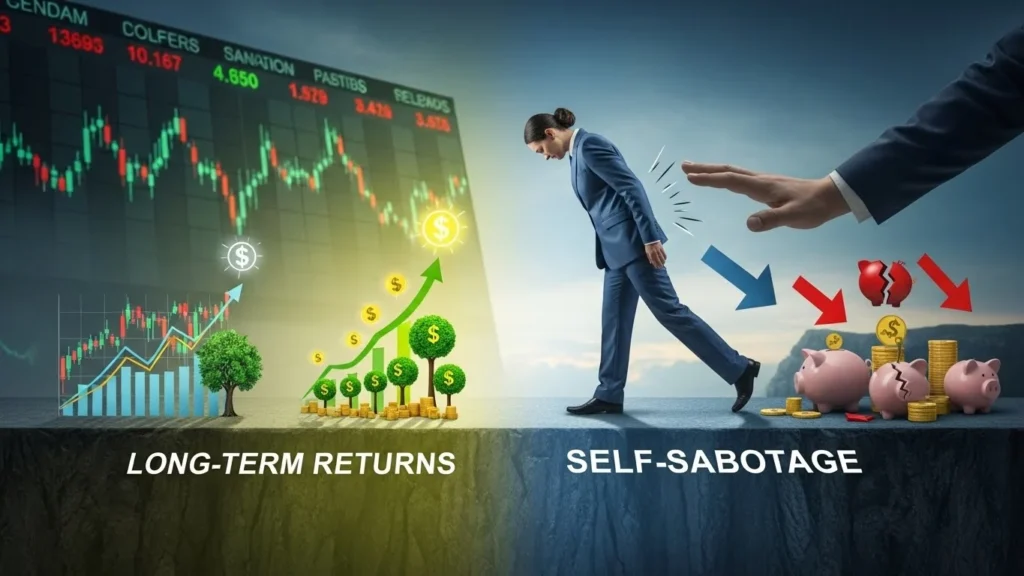
The Moment That Changes Everything
It almost always happens the same way.
Markets fall.
Headlines turn dark.
Portfolios bleed red.
Suddenly, the plan that once felt solid begins to feel reckless.
What was once called “long-term discipline” now feels like denial.
And that’s when investors abandon their strategy—right when it matters most.
Not because the plan was wrong.
But because emotions hijacked the process.
This single moment explains why so many investors underperform the very markets they invest in.
The Uncomfortable Truth: Plans Don’t Fail—People Do
Most investment plans are built during calm periods.
Returns look predictable.
Risk feels theoretical.
Confidence is high.
But plans are not tested in calm markets.
They are tested in chaos.
And when volatility arrives, the brain starts rewriting the rules.
What felt logical before suddenly feels dangerous.
This gap between planning and execution is where most long-term damage occurs.
Why This Matters Today (And Always Will)
Modern investing is emotionally harder than ever.
- Constant news alerts
- Real-time portfolio tracking
- Social media panic cycles
- Endless predictions of collapse or boom
The faster information moves, the faster fear spreads.
Investors are no longer reacting to markets—they’re reacting to emotions amplified by noise.
And that makes abandoning plans more tempting—and more costly—than ever.
The Psychology Behind Abandoning Plans
1. Loss Aversion Takes Control
Loss aversion makes losses feel far more painful than gains feel pleasurable.
When markets fall, the brain shifts from logic to survival mode.
The goal changes from “long-term growth” to “stop the pain now.”
This is why investors sell after declines—even when the original plan assumed volatility.
2. Short-Term Fear Overpowers Long-Term Thinking
Under stress, the brain prioritizes immediate threats.
Future rewards become abstract.
Long-term plans lose emotional weight.
Selling feels like relief—even if it guarantees long-term damage.
3. The Illusion of Control Through Action
Doing something feels better than doing nothing.
Selling feels decisive.
Holding feels passive.
Even when inaction is the smarter choice, action feels safer psychologically.
This is why investors often make moves that feel responsible but are mathematically harmful.
The Most Common Moments Investors Quit Their Plans
Plans are rarely abandoned randomly.
They’re abandoned during specific emotional windows:
- After sharp market declines
- During prolonged uncertainty
- When headlines predict prolonged collapse
- When peers start selling
- When portfolios cross psychological loss thresholds
These moments create emotional pressure strong enough to override logic.
A Simple Pattern Most Investors Don’t See
Here’s what typically happens:
- Market rises → confidence grows
- Volatility appears → doubt begins
- Losses deepen → fear dominates
- Investor exits → relief follows
- Market recovers → regret sets in
The worst decision often feels best in the moment.
Real-World Evidence: Behavior vs. Returns
Long-term data consistently shows:
- Average investors earn significantly less than market averages
- The gap is largely caused by poor timing decisions
- Selling during downturns and re-entering late is the primary culprit
Markets don’t punish risk.
They punish emotional timing.
Why Even Experienced Investors Fall Into This Trap
Experience doesn’t eliminate fear.
In some cases, it amplifies it.
Experienced investors often:
- Overanalyze risk
- Try to “optimize” timing
- Trust intuition during stress
Ironically, this leads to more interference—and worse outcomes.
Discipline matters more than experience during turbulence.
Comparison Table: Planned Investing vs. Emotional Investing
| Behavior | Planned Investor | Emotional Investor |
|---|---|---|
| Market declines | Sticks to strategy | Reacts to fear |
| News cycles | Filters noise | Follows headlines |
| Volatility | Expected | Feels threatening |
| Decisions | Rule-based | Emotion-based |
| Long-term outcome | Compounded growth | Missed recoveries |
The difference isn’t intelligence.
It’s emotional control.
The Hidden Reason Plans Feel Wrong at the Worst Time
Investment plans are built on probabilities—not certainty.
During downturns, probabilities feel unreliable.
The brain demands certainty.
But markets never provide certainty—only long-term odds.
Abandoning plans doesn’t reduce uncertainty.
It just locks in losses.
The Most Dangerous Thought Investors Have During Crashes
“This time is different.”
Every crisis feels unique when you’re inside it.
History feels irrelevant.
Recovery feels impossible.
Yet markets have recovered from wars, recessions, bubbles, and systemic shocks.
The feeling of permanence is psychological—not factual.
Why Checking Portfolios Too Often Makes Things Worse
Frequent monitoring increases emotional volatility.
The more you watch:
- The more losses dominate attention
- The harder patience becomes
- The greater the urge to act
Long-term plans fail faster under constant observation.
Less checking = better discipline.
Mistakes That Almost Guarantee Plan Abandonment
- Changing strategy during market stress
- Consuming excessive financial news
- Comparing losses with others
- Looking for reassurance from headlines
- Treating investing as prediction instead of process
These behaviors weaken conviction exactly when strength is needed.
How Successful Investors Stay Invested When It’s Hardest
They don’t rely on willpower.
They rely on structure.
1. They Decide in Advance What Not to Do
Rules are set before emotions arrive.
- When not to sell
- When not to change strategy
- When not to react
This removes decision-making during panic.
2. They Focus on Time, Not Timing
Long-term investors measure success in decades—not months.
They understand that volatility is the price of growth.
Trying to avoid discomfort usually avoids returns too.
3. They Separate Market Noise From Personal Goals
Markets fluctuate.
Goals don’t.
Successful investors anchor decisions to life goals—not headlines.
Actionable Steps to Prevent Abandoning Your Plan
- Write down why your plan exists
- Define acceptable volatility ranges
- Limit how often you check portfolios
- Automate contributions and rebalancing
- Review strategy only during calm periods
The goal is not emotional suppression—but emotional insulation.
Why Staying Invested Feels Hard—but Works
Markets reward patience unfairly.
Those who endure discomfort capture recoveries.
Those who flee volatility often re-enter after gains are gone.
Staying invested isn’t heroic.
It’s quietly rational.
Key Takeaways
- Investors abandon plans during emotional stress, not logical failure
- Fear feels protective but is often destructive
- Timing mistakes cause long-term underperformance
- Structure beats willpower
- Discipline during downturns defines long-term success
Frequently Asked Questions (FAQs)
1. Is it ever okay to change an investment plan?
Yes—but only due to life changes or long-term goals, not short-term market stress.
2. Why do markets recover after most people sell?
Because selling pressure peaks near maximum fear, not maximum risk.
3. Can diversification prevent panic?
It helps reduce volatility, but discipline is still required.
4. How long should investors stay invested?
As long as the original goals and time horizon remain unchanged.
5. What’s the biggest mistake during market downturns?
Letting short-term fear override long-term strategy.
Conclusion: The Real Test of Investing
Investment success isn’t decided during calm markets.
It’s decided in moments of doubt.
The investors who build wealth aren’t braver or smarter.
They’re simply better at not abandoning themselves when fear shows up.
Your plan doesn’t need saving.
Your reactions do.
Disclaimer: This article is for general educational purposes only and does not provide personalized financial advice.

Selina Milani is a personal finance writer focused on clear, practical guidance on money, taxes, insurance, and investing. She simplifies complex decisions with research-backed insights, calm clarity, and real-world accuracy.


Pingback: Why Emotional Discipline Matters More Than Strategy: The Quiet Skill That Separates Winning Investors From the Rest
Pingback: How Information Overload Harms Investors: Why More Data Is Quietly Making Decisions Worse