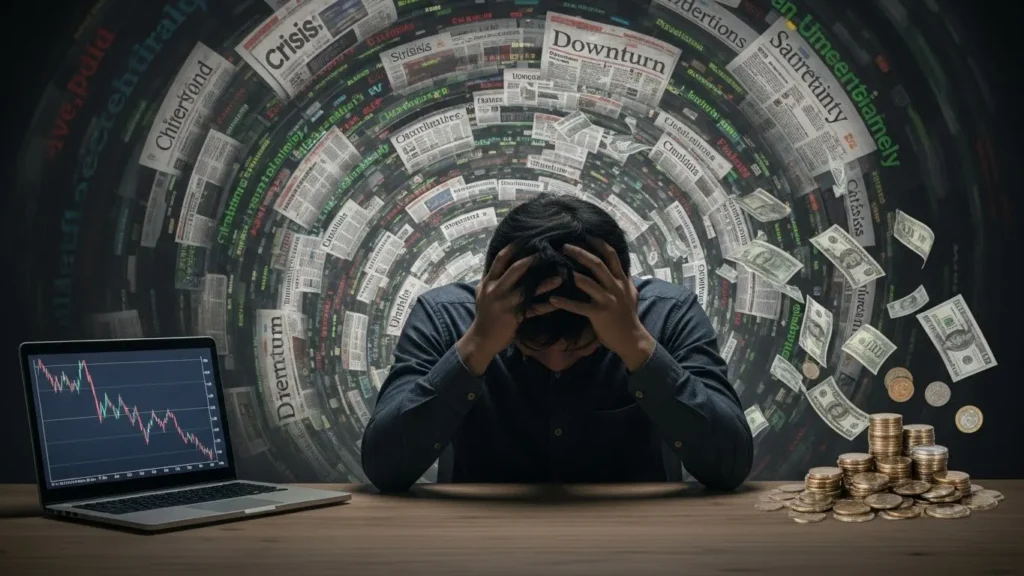
The Headline That Made You Pause
You weren’t planning to act.
But then you saw the headline.
It was urgent. Alarming. Confident.
It hinted that something big was happening—and that waiting could be costly.
So you checked your portfolio.
You reconsidered a decision.
You felt the pull to do something.
That moment—small and almost invisible—is where the cost of reacting to headlines begins.
Not all at once.
But quietly. Repeatedly. Over time.
Why This Matters Today (Even If You Don’t Follow the News Closely)
You don’t need to be glued to financial TV to be affected.
Headlines now live:
- On your phone lock screen
- In social media feeds
- Inside group chats
- Between unrelated articles you’re reading
The modern world is optimized for reaction, not reflection.
And markets punish reaction far more often than they reward it.
How Headlines Are Designed to Trigger Action
Headlines are not neutral.
They are engineered to:
- Capture attention instantly
- Trigger emotion before analysis
- Create urgency
- Reduce nuance
Common headline techniques include:
- Absolute language (“collapse,” “surge,” “crisis”)
- Time pressure (“now,” “immediately,” “before it’s too late”)
- Emotional framing (fear, outrage, excitement)
Their goal isn’t to help you decide wisely.
It’s to make sure you don’t ignore them.
The Psychological Tax of Constant Reactivity
Reacting to headlines doesn’t just affect money.
It affects:
- Stress levels
- Confidence
- Sleep quality
- Decision fatigue
- Long-term focus
Each reaction may feel harmless.
But over time, they compound into:
- Overtrading
- Missed opportunities
- Poor timing
- Emotional burnout
The cost is cumulative—and rarely obvious until years later.
Why Reacting Feels Responsible (But Often Isn’t)
Ignoring news feels careless.
Reacting feels prudent.
This illusion is powerful because:
- Society rewards being “informed”
- Inaction is mistaken for laziness
- Action feels like control
But markets don’t reward vigilance.
They reward discipline and restraint.
Knowing something happened is not the same as needing to act on it.
A Real-Life Example: The Headline Cycle Trap
Consider this common pattern:
- A negative headline breaks
- Fear spikes across media
- Prices fall briefly
- Investors sell to “avoid further losses”
- Markets stabilize or recover
- Those who sold buy back later—at higher prices
The loss doesn’t come from the headline.
It comes from reacting at the worst possible moment.
The Difference Between Information and Noise
Not all news is useless.
But most headlines fall into the category of noise, not signal.
Noise:
- Is short-term
- Is emotionally charged
- Lacks actionable relevance
- Disappears quickly
Signal:
- Affects long-term fundamentals
- Unfolds slowly
- Requires context
- Rarely arrives with urgency
Headlines blur this distinction on purpose.
Reacting vs Responding: A Critical Difference
| Reacting to Headlines | Responding Thoughtfully |
|---|---|
| Emotional | Deliberate |
| Immediate | Timed |
| Impulsive | Rule-based |
| Short-term focus | Long-term focus |
| High stress | Low stress |
Reacting is automatic.
Responding is intentional.
One drains value.
The other protects it.
The Financial Cost of Headline-Driven Decisions
Studies in behavioral finance consistently show:
- Frequent trading reduces returns
- Emotional decisions increase mistakes
- Market timing underperforms staying invested
Hidden costs include:
- Transaction fees
- Taxes
- Missed recovery periods
- Opportunity cost
The most damaging decisions often feel reasonable at the time.
Why Headlines Hit Harder During Uncertainty
Uncertainty amplifies fear.
During unclear periods:
- Brains crave certainty
- Headlines offer simple explanations
- Action feels comforting
But uncertainty is not a signal to act.
It’s a signal to slow down.
Complex systems don’t respond well to rushed decisions.
Hidden Tip: Most Headlines Are Forgotten—Your Decisions Aren’t
Here’s a revealing exercise:
Try recalling last month’s “urgent” headlines.
Most are gone.
But the decisions made under their influence?
Those remain.
Markets recover.
Trends reverse.
Narratives shift.
But impulsive decisions leave permanent marks.
Common Mistakes People Make When Reacting to News
Avoid these traps:
- Making decisions the same day a headline appears
- Confusing commentary with analysis
- Acting without revisiting long-term goals
- Overestimating short-term impact
- Assuming “this time is different” without evidence
Urgency is rarely your friend.
Actionable Steps to Reduce Headline-Driven Decisions
You don’t need to avoid news completely.
You need boundaries.
- Create a delay rule
Never act on news within 48–72 hours. - Limit news intake windows
Check once daily—or less. - Anchor decisions to a written plan
Headlines shouldn’t rewrite strategy. - Track decisions, not news
Measure outcomes over time. - Ask one question before acting:
Will this matter in five years?
Why Long-Term Thinkers Win Quietly
The most successful decision-makers:
- Consume less breaking news
- Focus on fundamentals
- Trust systems over instincts
- Accept short-term discomfort
- Stay consistent when others panic
They don’t look uninformed.
They look unmoved.
Key Takeaways
- Headlines are designed to provoke reaction, not wisdom
- Emotional decisions carry hidden financial and psychological costs
- Most news is noise, not signal
- Reacting feels responsible but often backfires
- Delayed, rule-based decisions protect long-term outcomes
Frequently Asked Questions (FAQ)
1. Should I completely ignore financial news?
No. Consume selectively and avoid acting impulsively on breaking headlines.
2. Why do headlines feel more urgent than they really are?
They’re optimized for attention, not long-term relevance.
3. How long should I wait before acting on news?
At least 48–72 hours—longer for major decisions.
4. Aren’t fast reactions sometimes necessary?
Rarely. Most impactful changes unfold over time, not hours.
5. What’s the safest way to handle market-related news?
Filter it through a long-term plan instead of emotions.
Conclusion: The Quiet Advantage of Not Reacting
Reacting to headlines feels like staying engaged.
But in reality, it often means surrendering control to noise.
The cost isn’t just financial.
It’s mental. Emotional. Strategic.
The ability to pause—to not react—is a competitive advantage.
In a world shouting for your attention,
the calm decision-maker quietly moves ahead.
Disclaimer: This article is for general educational purposes and does not replace personalized financial guidance.

Selina Milani is a personal finance writer focused on clear, practical guidance on money, taxes, insurance, and investing. She simplifies complex decisions with research-backed insights, calm clarity, and real-world accuracy.


Pingback: Why Consistency Beats Complexity in Investing (And Why Most People Get This Backward)