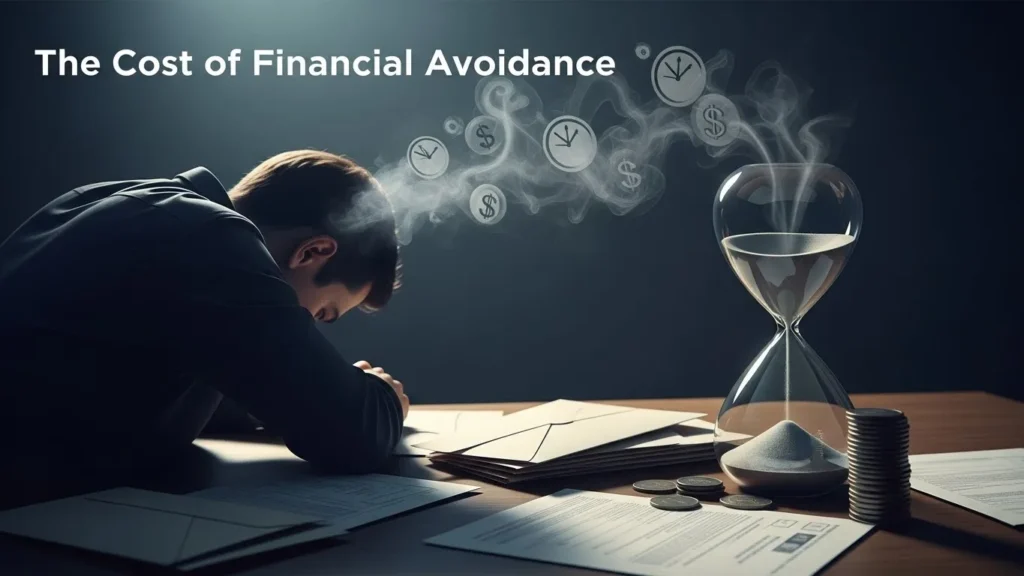
The Problem That Grows While You Look Away
Most financial damage doesn’t happen suddenly.
It happens quietly.
A bill left unopened.
An account not checked.
A decision postponed “until later.”
Later becomes weeks.
Weeks become years.
This habit has a name: financial avoidance.
And while it may feel like temporary relief, financial avoidance almost always comes with a cost—one that compounds over time in money, stress, and lost opportunity.
What Financial Avoidance Really Looks Like in Everyday Life
Financial avoidance isn’t always obvious.
It doesn’t always look like panic or chaos.
Often, it looks like:
- Not opening bank or credit card apps
- Avoiding budget conversations
- Postponing paperwork indefinitely
- Ignoring small issues until they feel overwhelming
- Saying “I’ll deal with it later” repeatedly
On the surface, it feels like stress reduction.
In reality, it’s stress delayed—and multiplied.
Why People Avoid Money (Even When They Know Better)
Money triggers strong emotions.
For many people, finances activate:
- Fear of not being enough
- Shame about past decisions
- Anxiety about uncertainty
- Overwhelm from complexity
Avoidance becomes a coping mechanism.
When looking creates discomfort, the brain chooses relief.
But that relief is temporary—and costly.
The Short-Term Comfort, Long-Term Damage Trade-Off
Financial avoidance offers something powerful in the moment:
- Emotional relief
- Fewer uncomfortable thoughts
- A sense of escape
But the long-term trade-off is steep:
- Missed payments
- Accruing fees or interest
- Growing uncertainty
- Lost confidence
The cost isn’t just financial.
It’s psychological.
The Real Costs of Financial Avoidance (Beyond Money)
Financial avoidance quietly drains multiple areas of life.
It costs:
- Time — fixing problems later takes longer
- Energy — constant background anxiety
- Opportunities — missed chances to save or invest
- Confidence — self-trust erodes with each delay
What feels like inaction is actually negative progress.
Financial Avoidance vs Financial Awareness
| Area | Financial Avoidance | Financial Awareness |
|---|---|---|
| Emotional state | Temporary relief, long-term stress | Initial discomfort, long-term calm |
| Decision-making | Delayed or reactive | Proactive and intentional |
| Problem size | Grows silently | Shrinks with attention |
| Sense of control | Low | High |
| Long-term outcomes | Fragile | Resilient |
Avoidance doesn’t freeze problems.
It feeds them.
Real-Life Example: The Unopened Statement Problem
Consider a common scenario.
Someone avoids opening bank statements because balances feel stressful.
Months pass.
A small issue becomes:
- Missed payments
- Fees
- Credit damage
- Higher anxiety
Eventually, the problem must be faced—but now it’s bigger, scarier, and more expensive.
Avoidance didn’t remove the problem.
It amplified it.
Why Financial Avoidance Feels Safer Than It Is
Avoidance tricks the brain.
Doing nothing feels neutral.
It feels like choosing not to make a mistake.
But in finance, inaction is still a decision.
And it often carries more risk than thoughtful action.
The Emotional Loop That Keeps People Stuck
Financial avoidance often follows a predictable loop:
- Money causes discomfort
- Avoidance reduces discomfort temporarily
- Problems grow silently
- Anxiety increases
- Avoidance feels even more necessary
This loop feeds itself.
Breaking it requires gentle engagement, not pressure.
Why This Matters Today (More Than Ever)
Modern finances are complex.
People face:
- Multiple accounts
- Digital payments
- Constant notifications
- Endless financial advice
When systems feel overwhelming, avoidance feels tempting.
But today’s financial environment punishes neglect faster than ever.
Attention—not perfection—is the real advantage.
The Hidden Cost: Lost Learning and Confidence
Every avoided moment is a missed learning opportunity.
Avoidance prevents:
- Skill development
- Familiarity with finances
- Confidence-building experiences
Over time, people don’t just avoid money.
They start to believe they can’t handle it.
That belief is often more damaging than any financial mistake.
Common Financial Areas People Avoid Most
Financial avoidance shows up most often in:
- Debt balances
- Credit reports
- Insurance reviews
- Retirement planning
- Expense tracking
Ironically, these are the areas where small attention creates the biggest relief.
Mistakes People Make When Trying to Stop Avoiding Money
Many people swing too far in the opposite direction.
Common mistakes:
- Trying to fix everything at once
- Using fear as motivation
- Comparing themselves to others
- Expecting instant confidence
This often leads back to avoidance.
Slow progress works better than pressure.
How to Break Financial Avoidance Without Overwhelm
1. Shrink the Task
Don’t “fix finances.”
Open one statement.
Check one balance.
Take one step.
2. Time-Box Financial Attention
Set a short window—10 to 15 minutes.
When time is limited, avoidance weakens.
3. Separate Awareness From Action
You don’t have to solve anything immediately.
Just seeing reality reduces fear.
4. Create a Simple Routine
Consistency beats intensity.
Weekly or monthly check-ins build familiarity.
5. Reward Engagement, Not Results
Confidence grows from showing up—not perfection.
A Hidden Tip Most People Miss
Avoidance thrives in vagueness.
Clarity—even when uncomfortable—often reduces fear immediately.
Knowing “this is the situation” is less stressful than imagining “it must be terrible.”
Financial Avoidance Is Human—But Not Harmless
Avoidance doesn’t mean laziness.
It means discomfort.
But untreated discomfort becomes expensive.
Facing finances isn’t about control.
It’s about relief.
Most people feel lighter—not worse—after engaging, even briefly.
Key Takeaways
- Financial avoidance offers short-term relief but long-term cost
- Ignoring money problems makes them grow silently
- Avoidance drains confidence, time, and peace
- Small, consistent engagement breaks the cycle
- Awareness reduces anxiety more than avoidance ever can
Frequently Asked Questions (FAQ)
Is financial avoidance common?
Yes. Many people avoid finances at some point, especially during stress or uncertainty.
Does avoidance mean someone is bad with money?
No. It usually reflects emotional overwhelm, not lack of intelligence.
What’s the fastest way to reduce money anxiety?
Brief, regular engagement—without pressure to fix everything.
Can financial avoidance affect mental health?
Persistent stress from unresolved finances can increase anxiety over time.
How do I start if I feel completely overwhelmed?
Start with visibility only. Awareness comes before action.
Conclusion: Looking Away Is More Expensive Than Looking In
Financial avoidance feels like protection.
But it quietly steals:
- Peace
- Progress
- Confidence
Facing money doesn’t require courage—it creates it.
Even small steps restore control.
And control, more than perfection, is what financial well-being is built on.
Disclaimer: This article is for general educational purposes only and does not replace personalized financial guidance.

Selina Milani is a personal finance writer focused on clear, practical guidance on money, taxes, insurance, and investing. She simplifies complex decisions with research-backed insights, calm clarity, and real-world accuracy.


Pingback: How Money Decisions Are Influenced by Fear — The Invisible Force Behind Most Financial Mistakes
Pingback: Why Fear of Taxes Quietly Pushes People Into Costly Financial Mistakes