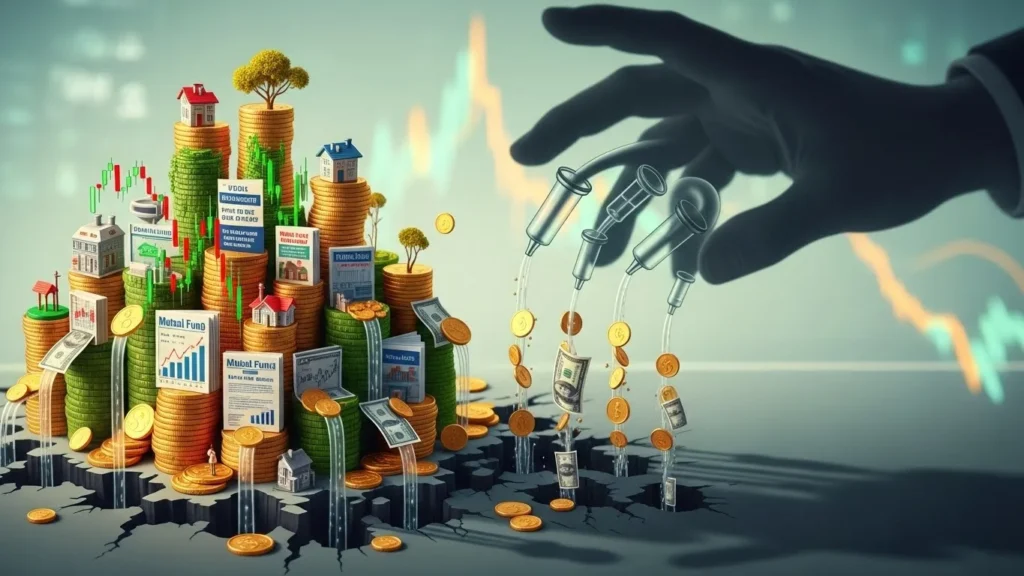
Your Portfolio Looks Fine — So Why Does Wealth Grow Slower Than Expected?
On paper, everything seems right.
Your investments show healthy returns.
Markets have moved in your favor.
You stayed invested through volatility.
Yet over the years, something feels off.
The growth doesn’t feel as powerful as the numbers suggest.
That missing piece is often tax drag—the slow, quiet reduction of returns caused by taxes that rarely show up clearly in performance reports.
Taxes don’t crash portfolios.
They leak value slowly, year after year.
And because the damage is subtle, most investors never address it.
Why This Matters More Than Market Timing
Most investors obsess over:
- Entry points
- Market cycles
- Fund selection
Very few track:
- After-tax returns
- Tax timing
- Portfolio tax efficiency
Yet research consistently shows that taxes can reduce long-term investment returns by 1–3% annually, depending on strategy and structure.
Over decades, that gap compounds into a massive difference in wealth.
Taxes don’t just take money.
They steal time, compounding, and optionality.
The Biggest Misconception: “Returns Are Returns”
Investment performance is often discussed in pre-tax terms.
That’s misleading.
What matters is:
What you keep after taxes, not what you earn before them.
Two investors can earn identical market returns and end up with dramatically different outcomes—purely because of tax decisions.
Where Taxes Quietly Reduce Investment Returns
1. Capital Gains Taxes Triggered Too Frequently
Every time you sell an asset at a profit, taxes step in.
The problem isn’t paying tax once.
It’s triggering gains too often.
Common causes:
- Frequent portfolio churn
- Short-term trading
- Rebalancing without tax awareness
Each sale interrupts compounding.
What could have grown uninterrupted now shrinks slightly—and repeatedly.
2. Dividend Taxes Creating Annual Drag
Dividends feel comforting.
They arrive regularly.
They feel like “income.”
But dividends are often taxed immediately, even if reinvested.
That means:
- Less money compounding
- Annual leakage regardless of market conditions
High-dividend strategies often look attractive—but can be tax-inefficient for long-term growth.
3. Interest Income Taxed at Higher Rates
Interest from:
- Bonds
- Fixed-income funds
- Certain savings instruments
is often taxed at ordinary income rates, not preferential capital gains rates.
This makes some “safe” investments surprisingly expensive after tax—especially for higher earners.
4. Short-Term vs Long-Term Tax Treatment
Holding period matters more than many realize.
Short-term gains:
- Often taxed at higher rates
- Triggered unintentionally through active trading
Long-term gains:
- Usually taxed more favorably
- Allow compounding to work longer
Many investors lose returns simply by not holding long enough.
A Simple Comparison: Pre-Tax vs After-Tax Reality
| Scenario | Pre-Tax Return | Tax Impact | After-Tax Outcome |
|---|---|---|---|
| Long-term holding | 10% | Deferred | Strong compounding |
| Frequent trading | 10% | Annual tax | Weakened growth |
| High dividends | 10% | Yearly tax drag | Lower net return |
| Tax-efficient strategy | 9% | Minimal | Often higher net |
The highest pre-tax return doesn’t always win.
The most tax-efficient return often does.
Real-Life Example: Two Investors, Same Market
Both investors earn similar market returns.
- Investor A trades actively
- Investor B holds long-term
After 20 years:
- Investor A paid recurring taxes on gains
- Investor B deferred taxes and compounded more capital
Result:
Investor B ends up with significantly more wealth, despite similar market performance.
Taxes, not markets, created the gap.
The Compounding Effect of Tax Drag
A 1% annual tax drag doesn’t sound dramatic.
But over time:
- 1% less per year
- Compounds against you
- Multiplies the opportunity cost
Over decades, this can mean tens or hundreds of thousands lost, depending on portfolio size.
Tax drag doesn’t scream.
It whispers—until it’s too late to recover lost compounding years.
Why This Matters Today (And Always Will)
Investment access has improved.
Costs have fallen.
Information is abundant.
Yet taxes remain structurally unavoidable.
Markets reward patience.
Tax systems reward planning.
Ignoring taxes today means:
- Working harder for the same outcome
- Taking more risk to compensate
- Feeling disappointed despite discipline
Hidden Tax Traps Most Investors Miss
- Reinvested dividends are still taxable
- Fund turnover creates embedded tax costs
- Capital gains distributions occur even without selling
- Switching funds can reset tax clocks
- “Low fee” doesn’t mean “tax efficient”
These aren’t advanced tricks.
They’re overlooked basics.
Actionable Ways to Reduce Tax Drag
1. Prioritize Holding Periods
Let compounding work uninterrupted whenever possible.
2. Be Strategic With Asset Location
Place tax-heavy assets where they’re taxed less aggressively.
3. Avoid Unnecessary Turnover
Every transaction should have a clear purpose beyond “market timing.”
4. Rebalance With Awareness
Timing matters. Structure matters. Taxes matter.
5. Focus on After-Tax Returns
Track what stays—not what shows on paper.
Common Mistakes to Avoid
- Chasing pre-tax performance numbers
- Overtrading during volatile markets
- Ignoring dividend taxation
- Assuming all returns compound equally
- Treating tax planning as an afterthought
Markets are unpredictable.
Tax rules are not.
Key Takeaways
- Taxes quietly reduce investment returns over time
- Tax drag compounds just like returns—negatively
- Pre-tax performance can be misleading
- Long-term, tax-efficient strategies often win
- After-tax returns matter more than market headlines
Frequently Asked Questions (FAQs)
1. Is tax drag really that significant?
Yes. Even small annual tax costs compound into major long-term losses.
2. Are dividends bad for investors?
Not inherently—but they can reduce compounding if taxed annually.
3. Does frequent trading increase taxes?
Almost always. It accelerates capital gains taxation.
4. Can tax efficiency outperform higher returns?
Often yes—especially over long time horizons.
5. Should tax planning come before investing?
It should evolve alongside investing, not after it.
A Simple, Grounded Conclusion
Taxes don’t ruin investments overnight.
They slow them down quietly, year after year.
The most successful investors aren’t just market-savvy.
They’re tax-aware.
When you start measuring success by what you keep, not what you earn, investment clarity finally clicks.
Disclaimer: This article is for general educational purposes and does not replace personalized tax or investment advice.

Selina Milani is a personal finance writer focused on clear, practical guidance on money, taxes, insurance, and investing. She simplifies complex decisions with research-backed insights, calm clarity, and real-world accuracy.


Pingback: Why Ignoring Tax Planning Costs More Than Market Losses — The Invisible Risk Most Investors Underestimate
Pingback: Why Getting Professional Tax Advice Pays for Itself (Even If You Think Your Taxes Are Simple)
Pingback: The Tax Traps of High-Yield Savings & Fixed Income — Why “Safe” Returns Often Shrink Faster Than You Expect