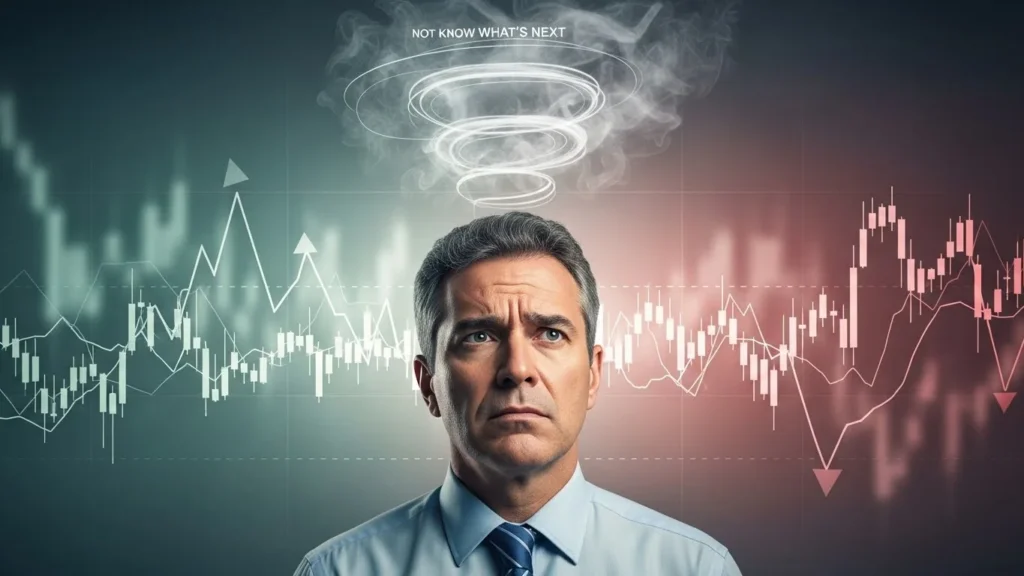
How Uncertainty Affects Investor Behavior
No one panics because the future is bad.
They panic because the future is unclear.
When investors say, “Markets feel risky right now,” what they usually mean is:
“I don’t know what’s coming next.”
Uncertainty—not loss—is the real trigger behind most emotional investment decisions.
Understanding how uncertainty affects investor behavior explains why people freeze, overreact, or abandon good plans exactly when patience matters most.
Why the Human Brain Dislikes Uncertainty So Much
The human brain evolved to prefer predictability.
Certainty meant safety.
Uncertainty meant danger.
In modern markets, this ancient wiring still dominates behavior.
When outcomes feel unclear, the brain:
- Scans for threats
- Overweights negative possibilities
- Pushes for immediate action
Unfortunately, investing rewards waiting, not reacting.
This mismatch between brain wiring and market reality is where many mistakes begin.
Uncertainty vs. Risk: A Crucial Difference Investors Confuse
Many people treat uncertainty and risk as the same thing.
They’re not.
- Risk is measurable. You can estimate probabilities.
- Uncertainty feels unknowable. Probabilities feel unreliable.
Markets are always risky—but they don’t always feel uncertain.
When uncertainty rises:
- Confidence drops
- Fear increases
- Rational analysis weakens
This is why investors often make worse decisions during uncertain periods—even when long-term data hasn’t changed.
What Uncertainty Does to Investor Behavior
When uncertainty enters the picture, predictable patterns appear.
Investors tend to:
- Delay decisions indefinitely
- Sell to “feel safe”
- Hold excess cash
- Seek reassurance from headlines
- Abandon long-term strategies
None of these behaviors are irrational in daily life.
But in markets, they often lead to missed growth and regret.
A Real-Life Example: Freezing at the Wrong Time
Consider an investor with a solid, diversified portfolio.
Markets become volatile.
Economic news feels confusing.
Predictions conflict.
Instead of sticking to the plan, the investor:
- Stops investing new money
- Waits for “clarity”
- Misses months or years of compounding
The irony?
Clarity usually arrives after markets recover.
Uncertainty delays action.
Delay reduces results.
Why Uncertainty Feels Worse Than Actual Losses
Studies in behavioral finance show something surprising:
Uncertainty activates stress responses similar to physical threats.
Not knowing what will happen often feels worse than knowing something bad will happen.
That’s why:
- Sideways markets feel exhausting
- Conflicting news causes anxiety
- Investors crave predictions—even unreliable ones
The brain prefers a bad answer over no answer.
How Uncertainty Amplifies Fear and Greed
Uncertainty doesn’t act alone.
It magnifies emotional extremes.
- Fear grows stronger when outcomes are unclear
- Greed grows louder when others seem confident
This leads to:
- Panic selling during unclear downturns
- FOMO buying during uncertain rallies
In both cases, uncertainty distorts perception—making short-term movement feel like long-term truth.
Uncertainty-Driven Investing vs. Process-Driven Investing
| Aspect | Uncertainty-Driven Behavior | Process-Driven Behavior |
|---|---|---|
| Decision Trigger | Headlines & emotions | Predefined rules |
| Response to Volatility | Freeze or flee | Rebalance or hold |
| Time Horizon | Short-term | Long-term |
| Stress Level | High | Lower |
| Consistency | Low | High |
| Outcomes | Often reactive | Often resilient |
The difference isn’t intelligence.
It’s structure.
Why This Matters Today (And Always Will)
Uncertainty is permanent.
- Economic shifts
- Political changes
- Technological disruption
- Unexpected events
Waiting for “certainty” means waiting forever.
The most successful investors don’t eliminate uncertainty—they learn how to function alongside it.
That skill matters more than predictions.
Common Mistakes Investors Make Under Uncertainty
Here’s what uncertainty quietly pushes people to do:
- Holding cash too long waiting for clarity
- Changing strategies repeatedly
- Consuming excessive financial news
- Seeking perfect timing
- Confusing caution with paralysis
Each mistake feels safe in the moment.
Over time, they quietly erode progress.
Why More Information Doesn’t Always Reduce Uncertainty
Many investors respond to uncertainty by consuming more information.
This often backfires.
Why?
- Information is conflicting
- Opinions cancel each other out
- Noise overwhelms signal
More information increases confusion, not clarity.
What reduces uncertainty isn’t information—it’s process.
How Experienced Investors Handle Uncertainty Differently
Experienced investors don’t predict better.
They prepare better.
They:
- Expect uncertainty
- Define rules before emotions rise
- Accept short-term discomfort
- Focus on controllable actions
They understand that uncertainty isn’t a flaw in markets—it’s the price of opportunity.
Practical Ways to Invest Smarter During Uncertainty
You don’t need confidence.
You need guardrails.
Actionable Steps That Work:
- Write decisions in advance
- What you’ll do during downturns
- Automate contributions
- Removes timing pressure
- Limit news exposure
- Once daily—or less
- Track goals, not forecasts
- Progress beats prediction
- Reframe uncertainty
- It enables long-term returns
A Powerful Reframing That Changes Everything
Instead of asking:
“What if things get worse?”
Ask:
“What if uncertainty is the reason long-term returns exist?”
Markets compensate investors for tolerating discomfort.
Uncertainty is not your enemy.
It’s the entrance fee.
Hidden Tip: Uncertainty Peaks Before Opportunity
Historically, periods of extreme uncertainty often precede:
- Strong recoveries
- Long-term value creation
- Opportunity for disciplined investors
This doesn’t mean taking reckless risk.
It means not abandoning your process when discomfort rises.
Frequently Asked Questions
1. Is uncertainty bad for investing?
Uncertainty feels bad—but it’s a normal part of investing and often linked to long-term opportunity.
2. Why do investors freeze during uncertain times?
The brain prioritizes safety over growth when outcomes feel unclear.
3. Can uncertainty be eliminated with better forecasts?
No. Forecasts often increase noise. Process matters more than prediction.
4. Should I stop investing during uncertain markets?
Stopping often leads to missed compounding. Consistency usually matters more than timing.
5. What’s the best mindset for uncertain markets?
Acceptance, structure, and long-term focus—not prediction.
Key Takeaways
- Uncertainty affects behavior more than actual losses
- The brain dislikes unclear outcomes and pushes for action
- Uncertainty-driven decisions often reduce long-term returns
- Structure and process outperform prediction
- Learning to live with uncertainty is a core investing skill
A Simple, Grounded Conclusion
You don’t need to feel certain to invest well.
You need a plan that works when certainty disappears.
Markets reward patience, not prediction.
Clarity often comes late—but discipline pays early.
When uncertainty rises, your behavior—not the market—matters most.
Disclaimer: This article is for educational purposes only and is not personalized investment advice. Financial decisions should reflect individual goals and risk tolerance.

Selina Milani is a personal finance writer focused on clear, practical guidance on money, taxes, insurance, and investing. She simplifies complex decisions with research-backed insights, calm clarity, and real-world accuracy.


Pingback: Why Long-Term Investors Still Make Short-Term Mistakes — The Hidden Psychology That Trips Up Even Disciplined Plans