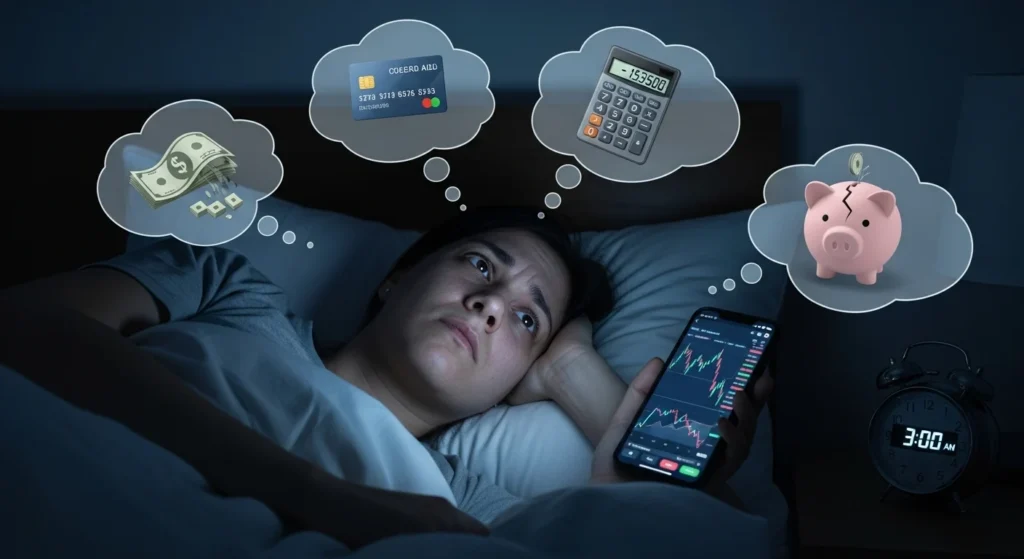
When Money Follows You to Bed
You turn off the lights.
The room is quiet.
But your mind isn’t.
Bills replay in your head.
Future expenses loop endlessly.
“What if something goes wrong?” won’t stop repeating.
Financial stress doesn’t just live in spreadsheets or bank accounts.
It follows you into bed — and quietly rewires how your body sleeps, heals, and copes.
Many people think poor sleep during financial stress is “just anxiety.”
In reality, it’s a biological response, driven by hormones, brain chemistry, and survival instincts that evolved long before modern money worries.
And when sleep breaks down, health soon follows.
Let’s explore how financial stress affects sleep and health, why it happens, and — most importantly — what you can do to protect yourself.
Why Financial Stress Hits Sleep So Hard
Financial stress is uniquely powerful because it feels unavoidable and unresolved.
Unlike short-term stressors, money worries:
- Have no clear end date
- Affect safety, housing, food, and identity
- Trigger constant future-focused thinking
Your brain interprets this as ongoing threat.
According to the American Psychological Association, financial stress consistently ranks as one of the top chronic stressors affecting adults — and sleep disturbance is one of its earliest symptoms.
The Biology Behind Money Stress and Sleepless Nights
When you worry about money, your body activates the stress response system.
Here’s what happens:
- Cortisol levels rise
Cortisol is meant to peak in the morning — not at night. Financial stress keeps it elevated when you’re trying to sleep. - The brain stays alert
The amygdala (threat detection center) remains active, preventing deep relaxation. - Melatonin production drops
Stress interferes with the hormone that signals sleep. - Sleep becomes lighter and fragmented
Even if you fall asleep, you wake more often and feel unrefreshed.
This is why financial stress causes:
- Difficulty falling asleep
- Early morning awakenings
- Racing thoughts at night
- Vivid, stressful dreams
Real-Life Example: Why “Being Tired” Isn’t the Real Problem
Consider this common scenario:
You’re earning enough to survive — but not enough to feel safe.
Unexpected expenses feel catastrophic.
Savings are thin or nonexistent.
At night:
- You replay every financial decision
- You calculate worst-case scenarios
- You mentally prepare for problems that haven’t happened
Even with 7–8 hours in bed, you wake exhausted.
The issue isn’t lack of sleep time.
It’s sleep quality, disrupted by financial vigilance.
How Poor Sleep From Financial Stress Affects Physical Health
Sleep is when the body repairs itself.
When financial stress disrupts sleep consistently, it affects nearly every system.
1. Heart and Blood Pressure
Chronic sleep disruption:
- Raises resting blood pressure
- Increases heart rate variability
- Elevates cardiovascular risk
The Centers for Disease Control and Prevention links poor sleep with higher rates of heart disease — especially when stress is ongoing.
2. Blood Sugar and Metabolism
Sleep loss affects insulin sensitivity.
This can lead to:
- Blood sugar spikes
- Increased cravings for quick energy foods
- Higher risk of weight gain
Financial stress often worsens this cycle because cheaper foods are typically less sleep-friendly.
3. Immune System Suppression
Poor sleep weakens immune defenses.
People under financial stress often notice:
- More frequent colds
- Slower recovery from illness
- Increased inflammation
Stress hormones divert energy away from immune repair.
The Mental Health Ripple Effect
Financial stress doesn’t just cause insomnia.
Insomnia amplifies financial stress.
This feedback loop fuels:
- Anxiety
- Irritability
- Low mood
- Reduced emotional regulation
Sleep-deprived brains are worse at:
- Problem-solving
- Emotional control
- Risk assessment
This makes money decisions feel harder — reinforcing the stress.
Comparison Table: Healthy Sleep vs Financial Stress Sleep
| Aspect | Healthy Sleep | Sleep Under Financial Stress |
|---|---|---|
| Sleep onset | Calm, gradual | Delayed, racing thoughts |
| Sleep depth | Deep, restorative | Light, fragmented |
| Hormones | Balanced cortisol | Elevated nighttime cortisol |
| Morning feeling | Refreshed | Fatigued, tense |
| Emotional state | Stable | Anxious, irritable |
| Health impact | Repair & recovery | Wear-and-tear accumulation |
Why This Matters Today (More Than Ever)
Financial uncertainty has become normalized.
Rising living costs, job instability, and unpredictable expenses mean more people are sleeping under stress than they realize.
The danger isn’t occasional worry — it’s chronic financial vigilance that quietly erodes health over years.
Sleep loss is often the first warning sign, not the last.
Hidden Ways Financial Stress Disrupts Sleep (That People Miss)
1. “Revenge Bedtime Procrastination”
People delay sleep to reclaim control after stressful days — scrolling, streaming, or doom-checking finances.
This worsens sleep timing and quality.
2. Irregular Sleep Schedules
Stress disrupts routines:
- Sleeping late on weekends
- Napping to compensate
- Inconsistent bedtimes
Your circadian rhythm thrives on predictability — stress removes it.
3. Alcohol as a Sleep Aid
Many people use alcohol to “turn off” money worries.
It may help with sleep onset — but:
- Fragments REM sleep
- Increases nighttime awakenings
- Worsens anxiety the next day
Mistakes to Avoid When Financial Stress Affects Sleep
- ❌ Trying to “outwork” exhaustion
- ❌ Ignoring sleep as a luxury
- ❌ Doom-scrolling finances before bed
- ❌ Using caffeine late to compensate
- ❌ Believing sleep problems will fix themselves
Sleep disruption from stress rarely resolves without intentional change.
Practical, Science-Backed Steps to Protect Sleep
1. Create a “Financial Cutoff Time”
Set a specific time (at least 90 minutes before bed) when:
- No budgeting
- No bill checking
- No financial planning
Your brain needs clear boundaries.
2. Externalize Worries
Before bed:
- Write down money concerns
- List what you can and can’t control
- Park unresolved thoughts on paper
This reduces nighttime rumination.
3. Anchor One Consistent Sleep Habit
Even small consistency helps:
- Same wake-up time
- Same wind-down routine
- Same sleep environment
Stability signals safety to the nervous system.
4. Regulate Stress Physiology First
Calming the body improves sleep faster than “positive thinking”:
- Slow breathing (4–6 breaths/minute)
- Gentle stretching
- Warm showers
These lower cortisol naturally.
When to Seek Extra Support
If financial stress is causing:
- Persistent insomnia
- Panic symptoms
- Depressive thoughts
- Physical symptoms without clear cause
Support from a sleep specialist, therapist, or financial counselor can dramatically improve outcomes.
Addressing both money stress and sleep together is far more effective than tackling either alone.
Key Takeaways
- Financial stress triggers biological stress responses that disrupt sleep
- Poor sleep amplifies anxiety, health risks, and decision fatigue
- Chronic sleep loss affects heart, metabolism, immunity, and mental health
- Small, consistent boundaries around money and sleep can restore balance
- Sleep is not a luxury — it’s a protective system
Frequently Asked Questions
1. Can financial stress really cause insomnia?
Yes. Financial stress activates stress hormones that interfere with sleep onset and depth, leading to chronic insomnia.
2. Why do money worries feel worse at night?
At night, distractions fade and stress hormones remain elevated, making worries feel louder and more intense.
3. Does poor sleep make financial stress worse?
Absolutely. Sleep deprivation reduces emotional control and problem-solving ability, amplifying stress perception.
4. Can improving sleep help financial decision-making?
Yes. Rested brains assess risk better, regulate emotions more effectively, and make clearer decisions.
5. How long does it take to recover sleep after chronic stress?
With consistent routines and stress regulation, improvements often begin within 2–4 weeks.
Conclusion: Sleep Is Your Silent Safety Net
Financial stress may feel unavoidable — but sleep damage doesn’t have to be.
When you protect your sleep, you protect:
- Your health
- Your resilience
- Your clarity
- Your ability to handle uncertainty
Money problems are easier to face with a rested nervous system.
Sleep isn’t escaping reality.
It’s preparing your body and mind to handle it better.
Disclaimer: This article is for educational purposes only and does not replace professional medical or mental health advice. If symptoms persist, consider consulting a qualified professional.

Selina Milani is a personal finance writer focused on clear, practical guidance on money, taxes, insurance, and investing. She simplifies complex decisions with research-backed insights, calm clarity, and real-world accuracy.