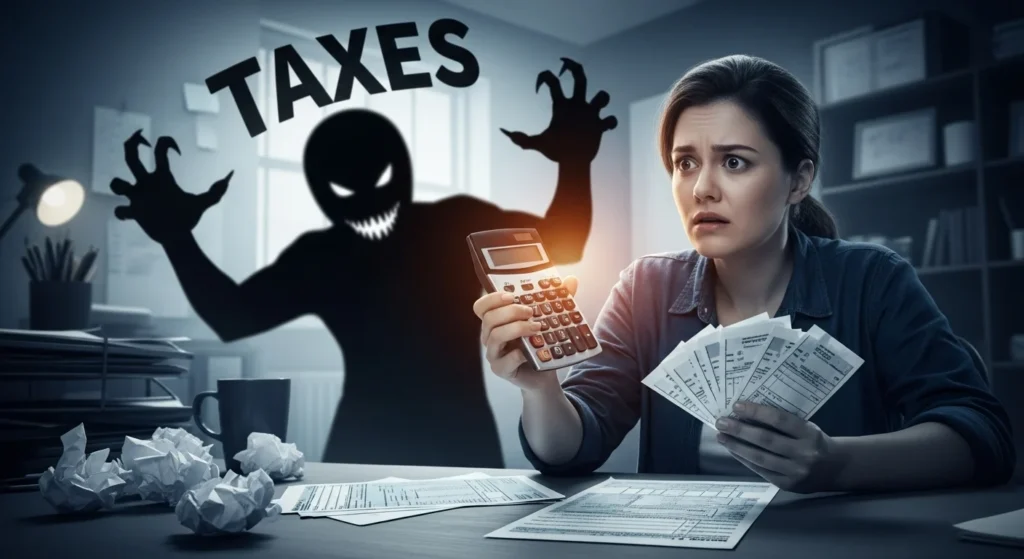
When Fear, Not Logic, Makes the Decisions
Most bad financial decisions don’t come from ignorance.
They come from fear.
Specifically, fear of taxes.
The fear of owing.
The fear of doing something wrong.
The fear of penalties, audits, or scrutiny.
Under fear, people don’t pause to evaluate options. They rush, avoid, delay, or overcorrect. And while these reactions feel protective in the moment, they often lead to worse financial outcomes over time.
Understanding how tax fear shapes behavior is the first step toward breaking the cycle.
What Tax Fear Really Is (And Why It’s So Common)
Tax fear isn’t just about numbers.
It’s psychological.
It often includes:
- Fear of making mistakes
- Fear of authority
- Fear of uncertainty
- Fear of future consequences
Taxes combine money, rules, deadlines, and authority—all classic stress triggers.
Add complexity and unclear language, and the brain switches from reasoning mode to threat-avoidance mode.
That’s when decision quality drops.
How Fear Changes the Way the Brain Handles Money
When fear is present, the brain prioritizes short-term relief over long-term benefit.
This leads to:
- Avoidance instead of planning
- Overpaying to “stay safe”
- Delaying important decisions
- Ignoring opportunities that feel risky
Instead of asking, “What’s the best option?”
People ask, “What will make this fear go away fastest?”
That shift quietly drives poor financial choices.
Bad Decision #1: Avoiding Legitimate Deductions
One of the most common fear-based mistakes is not claiming deductions.
Why?
People worry:
- “What if this isn’t allowed?”
- “What if it triggers scrutiny?”
- “What if I misunderstood the rules?”
So they skip deductions they’re entitled to—essentially paying extra taxes for emotional safety.
Tax authorities like Internal Revenue Service and HM Revenue & Customs don’t penalize legitimate deductions supported by documentation.
But fear convinces people otherwise.
Bad Decision #2: Rushing Financial Moves to “Get It Over With”
Fear creates urgency.
That urgency causes people to:
- Sell investments prematurely
- Lock in decisions without reviewing alternatives
- Accept suboptimal outcomes just to reduce anxiety
In many cases, waiting—even briefly—would lead to a better financial result.
But fear frames waiting as danger.
Bad Decision #3: Over-Reliance on Automation or Defaults
When people feel anxious, they hand control to systems.
They:
- Click default options without understanding them
- Assume “recommended” equals “best”
- Avoid reviewing summaries
Automation feels safe because it removes responsibility—but it also removes awareness.
Fear doesn’t disappear. It just hides until later.
Real-Life Example: Fear vs Calm Decision-Making
Person A: Fear-Driven
- Unsure about deductions
- Avoids claiming expenses
- Files quickly to reduce anxiety
Outcome: Pays more tax than necessary, still worries afterward.
Person B: Calm, Informed
- Reviews eligibility
- Documents decisions
- Asks clarifying questions
Outcome: Lower liability, confidence, clarity.
Same rules.
Different emotional state.
Very different outcome.
The Hidden Cost of Fear-Based Financial Behavior
Tax fear doesn’t just affect one filing.
It compounds over time.
Fear-based decisions lead to:
- Chronic overpayment
- Missed growth opportunities
- Poor cash flow planning
- Ongoing anxiety around money
Ironically, trying to avoid risk creates greater long-term financial risk.
Comparison: Fear-Driven vs Informed Financial Decisions
| Factor | Fear-Driven Decisions | Informed Decisions |
|---|---|---|
| Emotional state | Anxious | Calm |
| Time horizon | Short-term | Long-term |
| Decision quality | Reactive | Thoughtful |
| Tax outcome | Often worse | Optimized |
| Confidence | Low | High |
Money decisions improve when fear is replaced with understanding.
Why This Matters Today More Than Ever
Modern finances are layered:
- Multiple income streams
- Digital platforms
- Complex reporting rules
Complexity amplifies fear.
Without awareness and support, people default to avoidance or oversimplification—both of which increase mistakes.
As systems become more automated, emotional intelligence around money matters more, not less.
Common Fear-Based Mistakes to Avoid
Watch for these patterns:
- Paying extra “just in case”
- Avoiding questions out of embarrassment
- Delaying decisions until deadlines force them
- Confusing compliance with overpayment
- Treating uncertainty as danger
These behaviors feel safe—but they’re costly.
Hidden Tip: Fear Shrinks When You Replace Guessing With Clarity
Most tax fear comes from not knowing.
Clarity reduces fear faster than avoidance.
Simple steps like:
- Understanding basic categories
- Reviewing summaries slowly
- Keeping clear records
- Asking one informed question
can dramatically change emotional responses.
Actionable Steps to Break the Tax Fear Cycle
- Name the fear
Is it uncertainty, authority, or making mistakes? - Replace assumptions with facts
Fear thrives on guesses. - Slow down decision points
Urgency is often emotional, not real. - Document your reasoning
Confidence grows when decisions are supported. - Seek clarification, not reassurance
Understanding lasts longer than comfort.
Key Takeaways
- Tax fear is emotional, not logical
- Fear drives avoidance, rushing, and overpayment
- Calm awareness leads to better financial outcomes
- Understanding reduces anxiety more than avoidance
- Better decisions come from clarity, not urgency
Frequently Asked Questions
Is tax fear common?
Yes. Even experienced earners feel it due to complexity and authority dynamics.
Does fear increase audit risk?
Indirectly—fear can lead to rushed or inconsistent decisions.
Is overpaying safer than optimizing?
No. Paying more than required offers no additional protection.
Can tax software reduce fear?
It can reduce workload, but not emotional understanding.
What’s the fastest way to reduce tax anxiety?
Replacing uncertainty with clear, basic knowledge.
Conclusion: Calm Decisions Always Cost Less Than Fearful Ones
Taxes don’t become expensive because of rules.
They become expensive because fear pushes people into rushed, defensive choices.
When you slow down, seek clarity, and replace fear with understanding, financial decisions improve naturally.
Not because you took risks.
But because you stopped letting fear decide for you.
Disclaimer: This article is for general informational purposes only and does not replace personalized tax or financial advice.

Selina Milani is a personal finance writer focused on clear, practical guidance on money, taxes, insurance, and investing. She simplifies complex decisions with research-backed insights, calm clarity, and real-world accuracy.