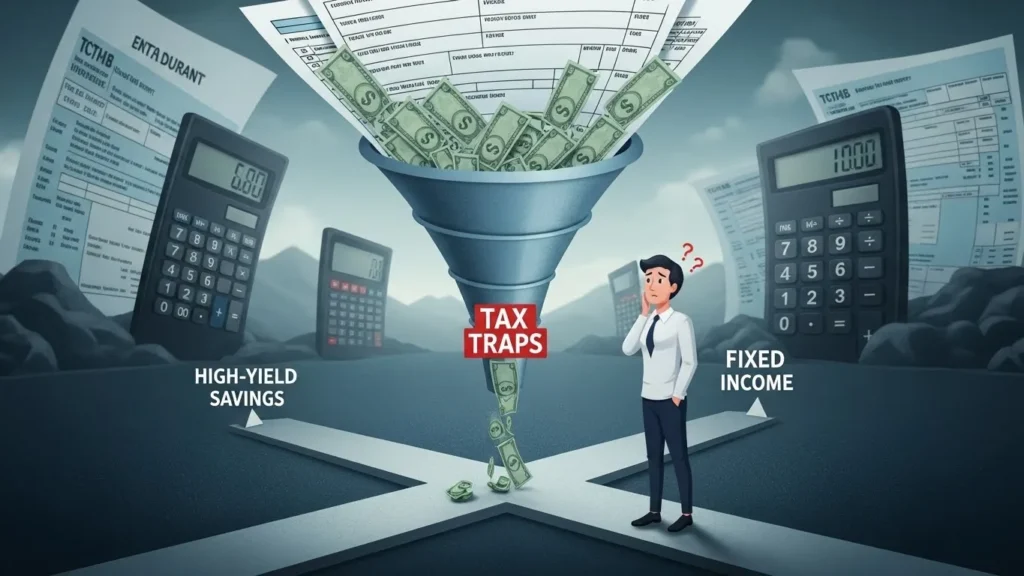
The Comforting Lie of “Guaranteed Returns”
High-yield savings accounts sound comforting.
Fixed income feels responsible.
Interest payments arrive like clockwork.
No volatility.
No stress.
No drama.
Yet many people are shocked years later when they realize their “safe money” barely moved forward — or worse, quietly lost ground.
The reason isn’t inflation alone.
It’s the tax traps built into high-yield savings and fixed income.
These investments are marketed as low-risk, but from a tax perspective, they are often highly inefficient. And because the damage is slow and subtle, it goes unnoticed for years.
This article explains where the tax drag hides, why conservative investors are often hit hardest, and how to protect your real returns without taking unnecessary risk.
Why High-Yield Savings Feel Better Than They Perform
High-yield savings accounts are psychologically satisfying.
You see:
- Steady growth
- No drawdowns
- Clear interest rates
- Daily liquidity
But tax systems don’t care about safety — they care about income classification.
Interest from savings accounts is usually treated as:
- Ordinary income
- Taxed every year
- Fully exposed to your marginal tax rate
That combination quietly erodes real wealth.
The Core Tax Problem: Interest Is the Worst-Taxed Income
Not all income is treated equally.
Interest income is often taxed:
- Immediately
- At the highest applicable rate
- Without deferral options
Authorities such as Internal Revenue Service and similar agencies worldwide classify interest as passive, fully taxable income, regardless of how “safe” it feels.
This means:
- No preferential rates
- No timing flexibility
- No compounding advantage before tax
Fixed Income Isn’t Tax-Efficient — It’s Tax-Predictable
Predictability feels like safety.
But predictability also means:
- Predictable taxation
- Predictable erosion
- Predictable long-term underperformance after tax
Fixed income generates regular cash flow, but that cash flow becomes taxable before it can compound.
That’s the silent cost most investors underestimate.
Real-Life Example: The “Safe” Portfolio That Went Nowhere
An investor builds a conservative portfolio:
- High-yield savings
- Fixed deposits
- Bonds
Nominal return looks reasonable.
After tax:
- Annual interest taxed immediately
- No deferral
- Inflation quietly eats purchasing power
Years later, the investor realizes their capital grew — but their financial freedom didn’t.
Comparison Table: Before-Tax vs After-Tax Reality
| Investment Type | Visible Return | Tax Treatment | Real Long-Term Effect |
|---|---|---|---|
| High-yield savings | Looks stable | Fully taxable annually | Quiet erosion |
| Bonds / fixed income | Predictable income | Taxed as ordinary income | Reduced compounding |
| Growth-focused assets | Volatile | Often tax-deferred | Stronger long-term growth |
| Tax-advantaged accounts | Structured | Deferred or reduced tax | Higher real return |
This gap is why conservative investors are often shocked by long-term results.
The Inflation + Tax Double Hit
Taxes don’t exist in isolation.
High-yield savings face a double penalty:
- Interest is taxed
- Inflation reduces purchasing power
If inflation equals or exceeds your after-tax return, your money is effectively standing still — or moving backward.
This happens quietly, year after year.
Why These Tax Traps Hurt Cautious People the Most
Ironically, the people trying to “do the right thing” suffer most.
Conservative savers:
- Avoid risk
- Prefer certainty
- Trust visible numbers
But tax systems reward:
- Deferral
- Long-term growth
- Asset appreciation
Safety without strategy becomes a slow leak.
Common Mistakes Investors Make With Fixed Income
These errors are widespread — and costly.
- ❌ Assuming “higher interest” means higher profit
- ❌ Ignoring after-tax returns
- ❌ Holding taxable fixed income long-term
- ❌ Overusing savings accounts for excess cash
- ❌ Confusing stability with efficiency
None of these feel like mistakes — until time exposes them.
Why This Matters Today (And Always Will)
Periods of higher interest rates bring renewed excitement around:
- Savings accounts
- Fixed income
- Guaranteed returns
But taxes don’t disappear when rates rise.
In fact, higher interest often means higher tax exposure, making planning even more important.
Hidden Tip: Tax Efficiency Matters More When Returns Are Low
When returns are modest:
- Taxes consume a larger percentage
- Small inefficiencies matter more
- Planning delivers outsized benefit
This is why tax-aware allocation matters most for conservative portfolios.
Smarter, Safer Ways to Reduce the Tax Drag
You don’t need to abandon safety.
You need to optimize it.
1. Use Tax-Advantaged Accounts
Shelter fixed income where possible.
2. Balance Growth and Income
Some growth reduces tax pressure long-term.
3. Match Assets to Tax Treatment
Not all income belongs in taxable accounts.
4. Think in After-Tax Terms
Before-tax returns are incomplete information.
Emotional Reality: Why People Resist Fixing This
High-yield savings feel comforting.
They provide:
- Control
- Liquidity
- Predictability
Changing strategy feels risky — even when the math says otherwise.
Understanding taxes helps replace fear with clarity.
Mistakes to Avoid When Adjusting Strategy
- ❌ Chasing yield blindly
- ❌ Taking risk without understanding volatility
- ❌ Moving everything at once
- ❌ Ignoring personal cash needs
Optimization is about balance, not extremes.
Key Takeaways
- High-yield savings and fixed income are heavily taxed
- Interest income is among the least tax-efficient returns
- Taxes + inflation quietly erode “safe” money
- Conservative investors face hidden long-term losses
- Small strategic adjustments can protect real returns
Frequently Asked Questions (FAQs)
1. Are high-yield savings accounts bad investments?
No — but they are often tax-inefficient for long-term wealth.
2. Why is interest taxed more heavily than other income?
Tax systems prioritize simplicity and immediate revenue from interest.
3. Does fixed income ever make sense?
Yes — especially for stability, income needs, and risk management.
4. Should I avoid bonds entirely?
No. They should be placed and used strategically, not avoided blindly.
5. What’s the biggest mistake conservative investors make?
Focusing on visible returns instead of after-tax, real returns.
Conclusion: Safety Without Strategy Isn’t Safety at All
High-yield savings and fixed income feel safe — and emotionally reassuring.
But without understanding taxes, that safety can quietly undermine long-term goals.
The real risk isn’t volatility.
It’s inefficiency you don’t notice until years later.
When safety and strategy work together, conservative investing finally delivers what it promises: stability and progress.
Disclaimer: This article is for general educational purposes only and does not replace personalized tax or investment advice. Always consider your individual situation before making decisions.

Selina Milani is a personal finance writer focused on clear, practical guidance on money, taxes, insurance, and investing. She simplifies complex decisions with research-backed insights, calm clarity, and real-world accuracy.