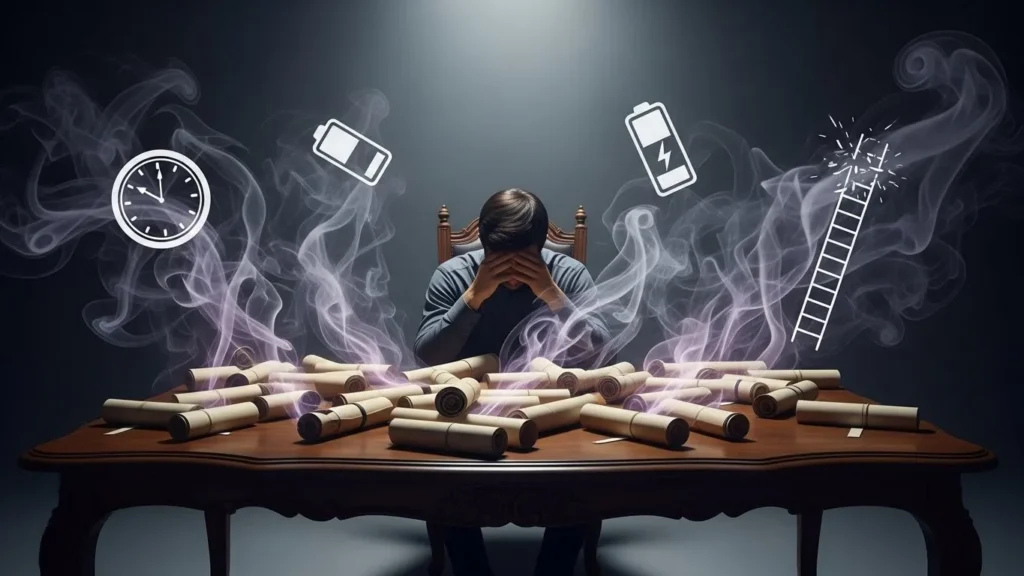
The Quiet Problem Almost Everyone Is Facing
It usually starts small.
You delay replying to an email because you want the “perfect” response.
You postpone a purchase because you want to research one more option.
You put off a career move because you’re waiting for clarity.
Nothing feels urgent.
Nothing feels wrong.
And yet—weeks pass.
This is decision paralysis.
Not loud.
Not dramatic.
Just quietly expensive.
It doesn’t look like failure.
It looks like thinking.
But beneath the surface, it drains your time, confidence, and momentum in ways most people never measure.
What Decision Paralysis Really Is (And What It’s Not)
Decision paralysis isn’t laziness.
It isn’t lack of intelligence.
And it isn’t indecision by choice.
It’s what happens when the mental cost of choosing feels higher than the cost of waiting.
At its core, decision paralysis is a state where:
- Too many options compete for attention
- The fear of regret outweighs the value of progress
- Mental energy gets consumed before action begins
The brain doesn’t shut down—it overheats.
And when that happens, delay feels safer than movement.
Why the Brain Freezes Instead of Choosing
The human brain evolved to make decisions in environments with limited options.
Modern life offers the opposite.
- Endless choices
- Constant comparison
- Permanent visibility of “better options”
- Social pressure to optimize everything
This creates cognitive overload.
Research in behavioral psychology consistently shows that more options increase anxiety, reduce satisfaction, and delay decisions.
The brain responds by protecting itself.
Not by choosing wrong.
But by choosing nothing.
The Hidden Costs People Rarely Notice
Decision paralysis doesn’t announce itself with obvious consequences.
Its damage is subtle.
1. Time Leaks That Add Up
You might not lose a day at once.
You lose:
- 10 minutes rethinking a message
- 30 minutes researching a decision you already know
- An hour circling the same options
Over weeks, this becomes days of lost time.
Time that never shows up as “wasted” on a calendar.
2. Energy Drain Without Action
Thinking feels productive.
But deep thinking without resolution is exhausting.
Decision paralysis consumes:
- Mental clarity
- Emotional energy
- Motivation
By the time you could act, you’re too drained to start.
3. Erosion of Self-Trust
Each delayed decision sends a subtle signal to your brain:
“I don’t trust myself to choose well.”
Over time:
- Confidence weakens
- Fear of future decisions increases
- Small choices feel heavier than they should
This creates a feedback loop.
The more you delay, the harder choosing becomes.
Decision Paralysis vs Thoughtful Decision-Making
Not all slow decisions are bad.
Here’s the difference.
| Thoughtful Decision-Making | Decision Paralysis |
|---|---|
| Clear criteria | Endless criteria |
| Time-limited thinking | Open-ended rumination |
| Accepts trade-offs | Seeks perfection |
| Moves forward | Stays stuck |
| Builds confidence | Reduces confidence |
The problem isn’t thinking deeply.
It’s thinking without a stopping rule.
Why Smart, Capable People Are Especially Vulnerable
Ironically, decision paralysis often affects:
- High performers
- Analytical thinkers
- Conscientious planners
Why?
Because they:
- See more variables
- Anticipate more outcomes
- Feel responsible for choosing “correctly”
The smarter the mind, the easier it is to overcomplicate.
What starts as diligence quietly turns into avoidance.
Real-Life Examples You Might Recognize
Career Choices
Someone stays in an unsatisfying job—not because it’s good, but because they can’t decide what’s “better enough” to leave.
Health Decisions
People delay simple lifestyle changes while waiting for the “perfect plan.”
Relationships
Conversations get postponed because the words don’t feel exactly right.
Purchases
Hours of research lead to no purchase at all.
In each case, the cost isn’t the wrong decision.
It’s inaction.
Why Decision Paralysis Feels Safer Than It Is
The brain treats uncertainty as a threat.
Choosing feels risky.
Waiting feels neutral.
But neutrality is an illusion.
Inaction is still a decision—just one that gives up control.
And the cost compounds quietly:
- Missed opportunities
- Slower growth
- Lingering dissatisfaction
The longer you wait, the harder it becomes to start.
The Psychological Traps That Fuel Paralysis
Understanding these traps makes them easier to escape.
Common Mental Traps
- Perfection bias: Believing the “right” choice must exist
- Regret avoidance: Overestimating future regret
- Option hoarding: Refusing to close doors
- Over-researching: Using information as a delay tactic
These traps feel responsible.
They are not.
How to Break Decision Paralysis Without Forcing Yourself
You don’t need to “be decisive.”
You need better decision structures.
Practical, Actionable Strategies
1. Set a Decision Deadline
Open-ended thinking leads to paralysis.
Even artificial deadlines work.
2. Limit Your Options Early
Reduce choices before analyzing them.
Fewer options = clearer thinking.
3. Define “Good Enough”
Most decisions don’t require perfection—just adequacy.
4. Separate Reversible vs Irreversible Decisions
Most choices are reversible.
Treat them accordingly.
5. Decide Based on Direction, Not Certainty
Progress creates clarity—clarity rarely comes first.
Mistakes to Avoid When Trying to Decide Faster
- Waiting for confidence before acting
- Seeking consensus on personal decisions
- Consuming more information instead of clarifying priorities
- Treating every choice as permanent
Speed comes from clarity—not pressure.
Why This Matters More Than People Think
Decision paralysis doesn’t just slow life down.
It quietly shapes the trajectory of it.
People don’t fail because they choose wrong.
They fail because they never choose at all.
In a world that rewards adaptability, the ability to decide and adjust is more valuable than the ability to optimize endlessly.
Momentum beats precision over time.
Key Takeaways
- Decision paralysis is a cognitive overload problem, not a character flaw
- Overthinking drains time, energy, and self-trust
- Inaction is still a decision—with real costs
- Smart people are often more vulnerable to paralysis
- Simple decision frameworks reduce mental load
- Progress creates clarity, not the other way around
Frequently Asked Questions (FAQs)
1. Is decision paralysis the same as procrastination?
No. Decision paralysis is driven by fear of choosing wrong, not avoidance of effort.
2. Can decision paralysis affect mental health?
Chronic indecision can increase stress and anxiety, though it’s not a medical condition itself.
3. Are some people naturally better decision-makers?
Yes, but skills and structures matter more than personality.
4. How many decisions should I limit per day?
Reducing non-essential decisions helps preserve mental energy for important ones.
5. What’s the fastest way to escape decision paralysis?
Introduce constraints—time, options, or criteria.
A Simpler Way to Think About Decisions
Most decisions don’t shape your life.
Your ability to move does.
Choosing imperfectly and adjusting beats waiting perfectly and staying still.
Clarity is rarely found by thinking longer.
It’s found by stepping forward.
Disclaimer: This article is for general informational purposes only and is not a substitute for professional psychological or medical advice.

Selina Milani is a personal finance writer focused on clear, practical guidance on money, taxes, insurance, and investing. She simplifies complex decisions with research-backed insights, calm clarity, and real-world accuracy.


Pingback: How Fear Alters Investment Decisions — The Silent Force That Pushes Smart People Into Bad Moves
Pingback: How Overthinking Money Leads to Inaction — The Silent Trap That Keeps People Stuck
Pingback: Why Financial Planning Feels Overwhelming (And How to Finally Make It Feel Manageable)